Evaluating the Ornament Orchid Pattern for High-Resolution Holiday Crafts
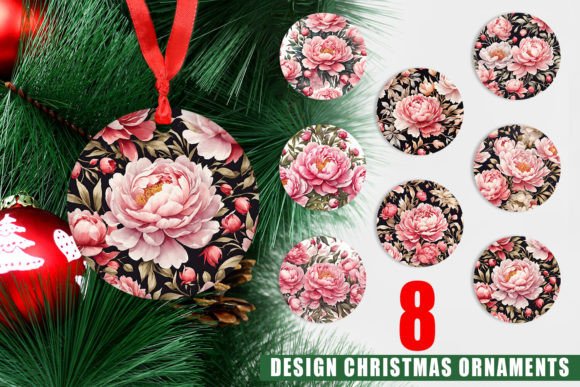
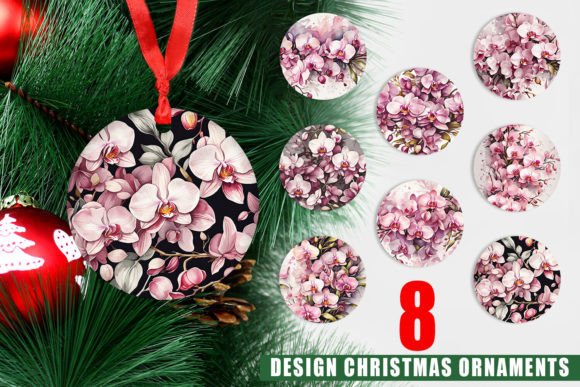
When curating a collection of holiday decorations, the choice of visual motif often dictates the overall aesthetic of the finished product. The Ornament Orchid Pattern has emerged as a sophisticated alternative to traditional botanical themes, offering a blend of organic fluidity and geometric precision that appeals to modern crafters. This specific design set, typically comprising eight circular decorative elements, is engineered for high-fidelity reproduction. Understanding the technical specifications—such as the 300 DPI resolution and 5x5 inch dimensions—is crucial for determining whether this pattern aligns with your specific project requirements compared to other available resources.
The distinct appeal of the orchid motif lies in its versatility. Unlike rigid geometric shapes or overly rustic pinecone illustrations, an orchid pattern introduces an element of elegance and softness. When applied to circular formats, such as Christmas ornaments, the curvature of the flower petals often complements the round edge of the substrate, creating a cohesive visual flow. For adults aged 20 to 50 who are evaluating design assets for personal use or small-scale production, the decision often comes down to the balance between artistic style and technical usability.
Technical Specifications and Print Readiness
A primary factor in selecting digital design assets is the resolution relative to the intended output size. The standard for professional-quality printing is 300 dots per inch (DPI). The Ornament Orchid Pattern set described here meets this benchmark, providing files at 1500x1500 pixels for a 5x5 inch print area. This specification is critical for several reasons:
- Clarity at Close Range: Christmas ornaments are often viewed from a short distance. Lower resolution images (such as 72 DPI web graphics) will appear pixelated or blurry when printed, detracting from the intricate details of the orchid petals.
- Scalability Limits: While 300 DPI is excellent for the native 5x5 inch size, users must understand the limitations if they intend to enlarge the design. Upscaling beyond the provided dimensions can result in a loss of sharpness, whereas vector-based alternatives might offer infinite scalability but lack the textured depth of a high-resolution raster PNG.
- Format Compatibility: The use of PNG files ensures support for transparency. This allows the orchid design to be layered over colored backgrounds, metallic papers, or textured substrates without a white bounding box, a feature not always present in JPEG formats.
Comparing this to other common formats, such as SVG or EPS, reveals a trade-off. Vector files are superior for large-format signage or vinyl cutting where size variation is extreme. However, for detailed, multi-colored botanical illustrations intended for direct printing on paper, cardstock, or sublimation blanks, a high-resolution PNG often preserves the nuanced shading and color gradients better than a flattened vector export.
Design Aesthetics: Orchid vs. Traditional Botanicals
In the landscape of holiday decor, floral patterns compete with evergreens, berries, and snowflakes. The Ornament Orchid Pattern offers a departure from the expected. Traditional holly and ivy designs convey a classic, perhaps nostalgic, winter feel. In contrast, orchids introduce a tropical or exotic warmth that can brighten a winter palette. This makes the design particularly suitable for:
- Modern Minimalist Decor: The clean lines of an orchid silhouette fit well within contemporary interior design schemes that avoid clutter.
- Non-Traditional Color Schemes: While red and green dominate the season, orchid patterns adapt seamlessly to gold, silver, blush pink, or deep navy themes, allowing for greater creative freedom.
- Year-Round Versatility: Unlike a snowflake which is strictly seasonal, an orchid design can potentially be repurposed for spring decor or general home accents, offering better long-term value for the creator.
However, readers should evaluate whether this aesthetic fits their target audience or personal taste. If the goal is a strictly traditional, "old-world" Christmas look, a more rustic botanical pattern might be preferable. The orchid's inherent elegance can sometimes feel too formal or delicate for crafts aiming for a cozy, farmhouse vibe.
Application Scenarios and Material Considerations
The utility of a digital design set is ultimately defined by how it performs across different materials. The 8 circular designs in this set are optimized for specific applications, but understanding the material interaction is key to a successful outcome.
Paper and Cardstock Projects
For those creating handmade ornaments using heavy cardstock or watercolor paper, the 300 DPI resolution ensures that fine lines in the orchid petals do not bleed or blur during the printing process. When using inkjet printers, it is advisable to select a "photo" or "high quality" setting to maximize the benefit of the high-resolution source file. Lamination or sealing with a clear coat can further protect the print, though one must test for color fastness first.
Sublimation and Hard Surfaces
A growing trend involves sublimating designs onto ceramic, metal, or acrylic ornament blanks. The PNG format with transparency is ideal here, as it allows the design to be placed directly onto the blank without background interference. The 1500x1500 pixel dimension is generally sufficient for standard 3-inch to 4-inch round blanks. However, for larger sublimation projects, users might find the fixed pixel dimensions limiting compared to vector sources, necessitating a careful check of the blank size before purchase.
Digital Integration
Beyond physical printing, these assets are valuable for digital invitations, social media graphics, or web banners. The high resolution allows for cropping and zooming while maintaining quality, a significant advantage over lower-tier stock imagery.
Decision Factors: When to Choose This Set
Selecting the right design resource involves weighing several variables. The Ornament Orchid Pattern set is likely the optimal choice if your priorities include:
- Immediate Usability: You need ready-to-print files without the need for complex vector editing software.
- Textural Detail: Your project relies on realistic shading and color depth that raster images handle better than simple vector fills.
- Specific Sizing: Your project dimensions align closely with the 5x5 inch format, minimizing the need for resizing.
- Elegant Aesthetic: You are aiming for a refined, less conventional holiday look.
Conversely, you may need to explore alternatives if:
- Variable Sizing is Critical: You plan to print the same design on items ranging from small tags to large posters; a vector format (SVG/AI) would be more robust.
- Cut Files are Required: If your primary workflow involves die-cutting machines that require path data rather than pixel data, a dedicated cut file format would be more efficient, although some crafters trace PNGs manually.
- Budget Constraints: Free, lower-resolution alternatives exist, but they often compromise on the crispness required for professional-looking results.
Maximizing the Value of the Design Set
To get the most out of a set of 8 circular designs, consider mixing and matching. Using a single pattern repeatedly can create a uniform look, but alternating between the different variations in the set adds visual interest to a tree or display. Some designs in such sets may feature full blooms, while others focus on buds or abstract petal arrangements. Evaluating the variety within the set helps determine if it provides enough diversity for your needs.
Furthermore, consider the color profile. Most high-quality PNGs are saved in sRGB, which is standard for web and most consumer printers. If you are working with a professional print shop that requires CMYK, you may need to convert the files, keeping in mind that this can slightly shift the vibrancy of certain orchid hues, particularly purples and pinks. Testing a single print run before committing to a large batch is a prudent step in any crafting workflow.
In conclusion, the Ornament Orchid Pattern represents a specialized tool in the crafter's arsenal. It bridges the gap between artistic expression and technical reliability. By offering high-resolution, transparent PNGs in a versatile circular format, it caters to users who prioritize print quality and elegant design. However, like any resource, its effectiveness depends on matching its specific strengths—resolution, format, and style—to the constraints and goals of your specific project. Careful evaluation of these factors ensures that the final ornaments are not only festive but also professionally executed.